Velocity Loss Thresholds in Resistance Training

A set does not become useful only when every repetition is slow. As fatigue accumulates, repetition velocity usually falls. Velocity-based training turns that change into a stopping rule: end the set when speed has declined by a chosen percentage from the fastest repetition.
A 20% velocity-loss threshold, for example, means stopping after the measured concentric speed falls about one fifth. The idea is appealing because it describes what happened today rather than assuming a fixed repetition count produces the same fatigue in everyone. But the number is still a proxy. It does not directly measure muscle damage, recovery, technique, or the adaptation you will get.
What velocity loss changes
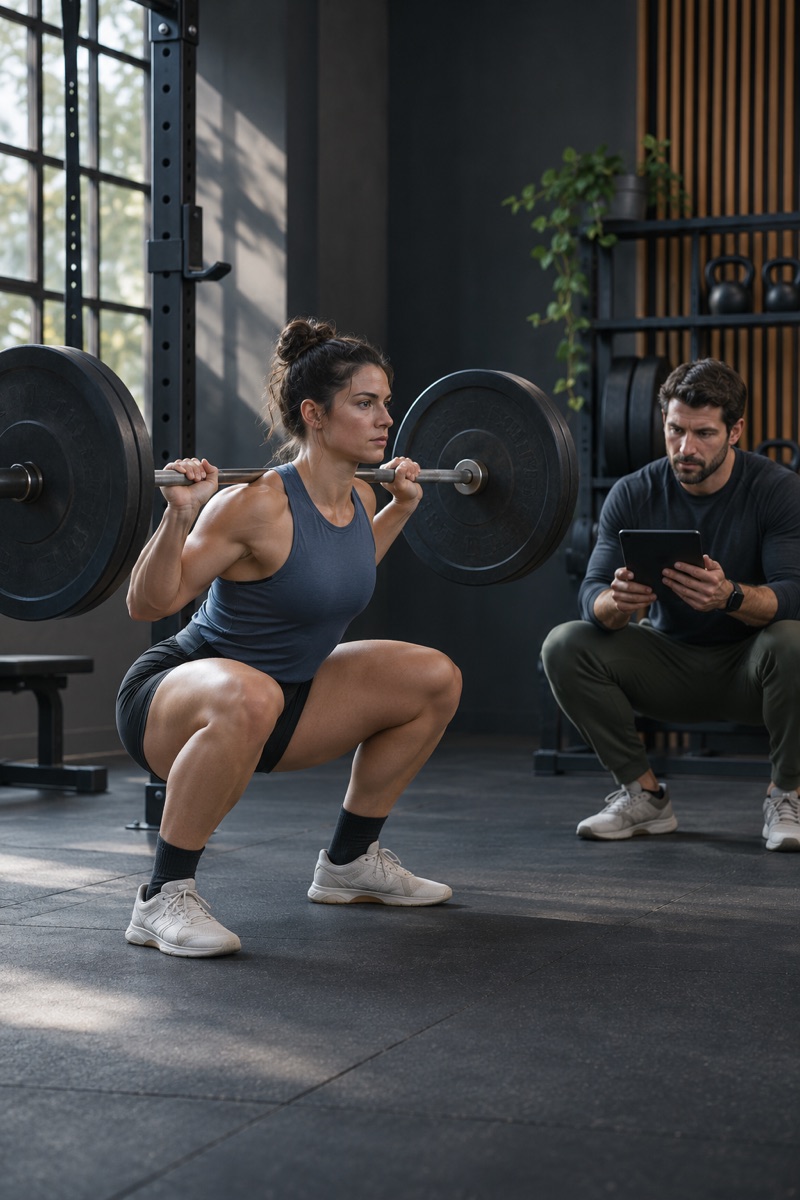
Higher thresholds generally allow more repetitions and more fatigue inside a set. A systematic review and meta-analysis found that increasing velocity loss was associated with greater acute volume, metabolic stress, perceived effort, and neuromuscular fatigue. Chronic outcomes were less tidy: strength and muscular endurance did not clearly improve as thresholds rose, while higher losses were associated with more hypertrophy and lower losses better preserved sprinting, jumping, and movement velocity.
Those findings should not be read as a universal menu. Exercises, loads, devices, training history, and how studies equated volume differed. Many trials involved trained young men. A dose-response meta-analysis suggested that roughly 20–30% loss may support maximal-strength development, while lower losses delivered more strength gain per repetition. That is an efficiency observation, not proof that one threshold is optimal for every lifter.
Strength and size are not the same target
Stopping early can preserve high-quality repetitions and limit fatigue, useful when strength, speed, or sport practice matters. Allowing a larger decline creates more repetitions near the slower end of the set and may support hypertrophy through added volume. Yet matched-volume research complicates the story: in one small within-person trial, 15% and 30% thresholds produced similar strength and muscle growth when total volume was controlled.
The practical conclusion is modest. Velocity loss can distribute fatigue, but it cannot rescue a poor program. Weekly hard-set volume, load, exercise selection, range of motion, nutrition, sleep, and progression still shape results.
Measurement has its own noise
Linear transducers, camera systems, and accelerometers are not interchangeable. Device placement, sampling rate, exercise path, and software filtering affect the number. The fastest repetition may also be an outlier. If a set begins with an awkward rep, the threshold can be reached too late; if one rep is unusually fast, it can arrive too early.
Use the same validated device and setup. Standardize range of motion and intention to move the concentric phase quickly. Consider using the fastest of the first few technically sound repetitions as the reference. Never speed through the eccentric phase or shorten depth merely to protect a velocity score.
A conservative starting framework
- Power or speed emphasis: consider a low threshold, often around 10–15%, to preserve movement quality.
- General strength: a moderate range such as 15–25% can control fatigue while permitting useful work.
- Hypertrophy emphasis: larger losses may accumulate more volume, but proximity to failure, weekly volume, and recovery still matter.
These are working ranges, not medical or coaching prescriptions. Beginners may benefit more from learning stable technique and a simple rep range than from buying a device. Older adults also need caution: a small 2024 trial found both 10% and 20% loss improved several lower-body outcomes, with 10% requiring fewer repetitions, but only 18 people completed the comparison.
How to use the threshold without becoming ruled by it
Define the exercise, load, target, and maximum set count before training. Record the reference speed and the repetition where the threshold was crossed. Stop sooner for technique breakdown, pain, dizziness, or loss of control. If the device gives a surprising reading, repeat only when it is safe and technically justified; do not chase the screen.
Review trends across weeks. If lower thresholds preserve performance in later sport practice or reduce unnecessary soreness while strength progresses, that is useful. If hypertrophy is the goal and volume has quietly collapsed, the threshold may be too restrictive. The best setting is the one that supports the full training plan, not the one that looks most scientific.
View on Amazon →
View on Amazon →
View on Amazon →
These are affiliate links. If you purchase, we may earn a small commission at no cost to you. We verified the listed editions. Read our disclosure.
The calm bottom line
Velocity loss is a useful fatigue-control rule, not a biological truth. Lower thresholds can protect speed and efficiency; higher thresholds can add volume and may favor hypertrophy. Evidence is still shaped by small samples and specific exercises. Start conservatively, standardize measurement, keep technique above the metric, and judge the method by progress and recovery over time.
Sources
Jukic et al., systematic review and meta-analysis, 2023; Zhang et al., dose-response meta-analysis, 2023; Andersen et al., matched-volume trial, 2024; Marques et al., older-adult trial, 2024.