
Ultra-Processed Foods and Appetite: What the Trial Shows

“Ultra-processed” is now used as both a scientific category and a cultural insult. The science is more specific. The NOVA system groups foods by the nature and purpose of processing. Its fourth group includes industrial formulations made largely from refined ingredients, additives, and substances not usually used in home cooking.
That definition can capture sugary drinks and packaged snacks, but also products with very different nutrient profiles. The category is useful for studying food environments; it is not a perfect verdict on every item inside it.
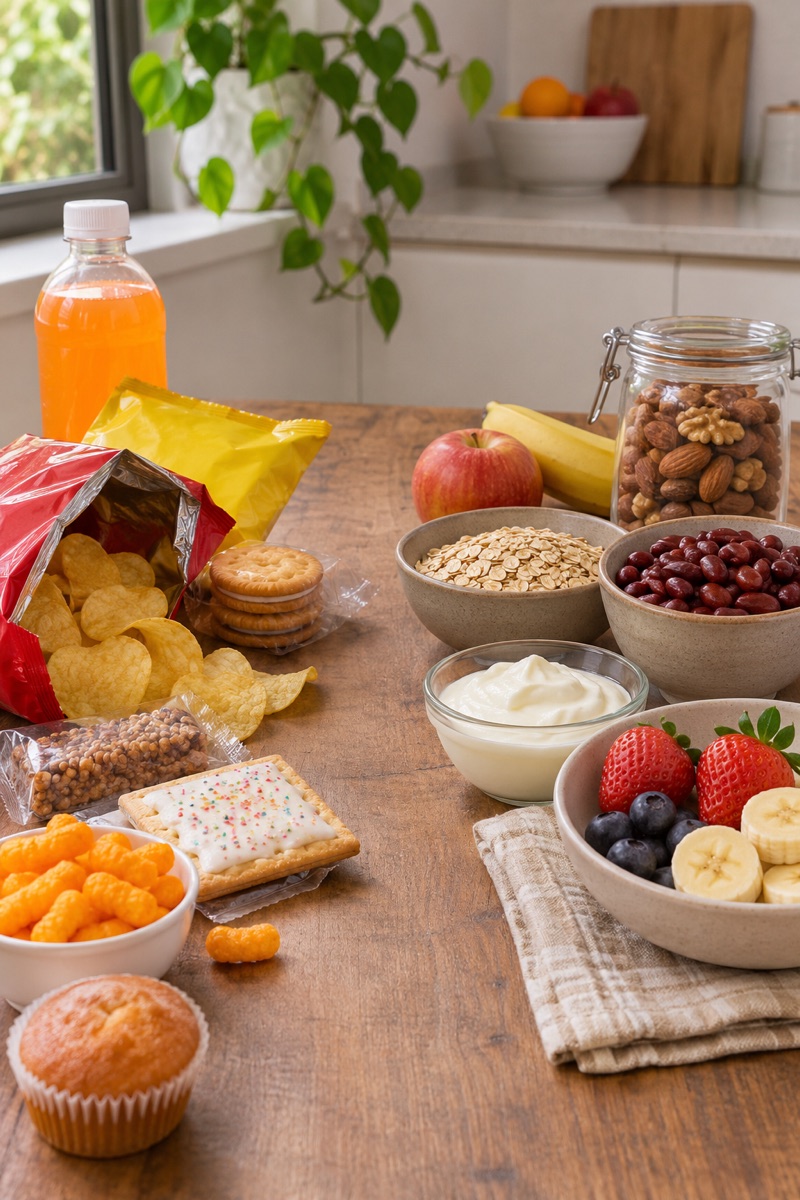
The strongest controlled experiment
In 2019, Kevin Hall and colleagues at the US National Institutes of Health admitted 20 adults to a metabolic ward for four weeks. Each participant received an ultra-processed diet for two weeks and an unprocessed diet for two weeks, in randomized order. Meals were designed to be presented as comparable in calories, energy density, macronutrients, sugar, sodium, and fiber. Participants could eat as much or as little as they wanted.
On the ultra-processed diet, participants consumed about 500 more kilocalories per day and gained roughly 0.9 kilograms. On the unprocessed diet, they lost a similar amount. Because the same people experienced both diets under controlled conditions, the experiment gives unusually strong evidence that the menus caused the short-term difference in intake.
What may have driven the effect
People ate the ultra-processed meals faster. Faster eating can deliver more energy before satiety signals fully influence the meal. The diets also differed in the proportion of calories from beverages and in energy density when drinks were included. Protein intake was similar in absolute terms, but the percentage of calories from protein fell when total intake rose—consistent with, but not proof of, a protein-leverage mechanism.
No single additive was isolated. The study tested two complete dietary patterns, so it cannot tell us that emulsifiers, flavors, texture, sugar, or packaging alone caused overeating. Multiple features may work together: softness, speed, convenience, concentrated energy, low structural complexity, and learned reward.
What the trial does not prove
Twenty participants and two weeks per diet are enough to detect a controlled short-term effect, not to establish every long-term outcome. The menus were deliberately contrasting and do not represent every real household. Weight change in a residential study also cannot tell us how people adapt over months when cost, culture, time, access, and preference shape eating.
Observational studies repeatedly link higher ultra-processed food intake with obesity, type 2 diabetes, cardiovascular disease, and mortality. Those associations matter, but residual confounding remains possible: people with different diets also differ in income, smoking, sleep, activity, and healthcare access. Strong associations plus a plausible controlled feeding result make concern reasonable, while still falling short of proving that every NOVA 4 product has the same effect.
A practical response without purity rules
Start with the foods that contribute the most calories and are easiest to eat quickly: sweet drinks, packaged desserts, chips, confectionery, and frequent fast-food meals. Reducing one repeat exposure can matter more than policing minor additives in a low-calorie food.
Build meals around recognizable protein, fiber-rich plants, and minimally processed staples: beans, eggs, fish, yogurt, oats, potatoes, whole grains, fruit, and vegetables. Processing itself is not the enemy. Frozen vegetables, canned beans, pasteurized milk, and whole-grain bread can be useful, affordable foods.
Change the environment before relying on restraint. Keep a ready option visible, portion highly rewarding snacks instead of eating from the package, and slow the first ten minutes of a meal. If cooking time is scarce, combine convenience items rather than demanding everything from scratch: canned lentils, frozen vegetables, microwave grains, and plain yogurt can make a complete meal quickly.
A seven-day experiment
- Record which packaged foods supply the most calories; do not count every additive.
- Choose one repeat item to replace, not an entire diet to ban.
- Add a protein-and-fiber anchor to breakfast or lunch.
- Prepare two convenient minimally processed foods in advance.
- Eat one meal without a screen and notice eating speed.
- Keep cost and waste visible; a sustainable swap must fit both.
- Review hunger, energy, enjoyment, and convenience—not only weight.
People with eating disorders, food insecurity, complex medical diets, or significant gastrointestinal disease should avoid rigid elimination rules and seek individualized support. A classification system should help explain patterns, not create fear around food.
View on Amazon →
View on Amazon →
View on Amazon →
These are affiliate links. If you purchase, we may earn a small commission at no cost to you. We only list books we researched. Read our disclosure.
Sources
Hall KD et al. Ultra-Processed Diets Cause Excess Calorie Intake and Weight Gain. Cell Metabolism. 2019;30:67–77. Monteiro CA et al. Ultra-processed foods: what they are and how to identify them. Public Health Nutrition. 2019;22:936–941.