
The Extended Mind Review: Thinking Beyond the Brain

Modern knowledge work often treats the brain like a sealed processor. Better performance supposedly comes from storing more, concentrating harder, and resisting the messy world outside the skull. In The Extended Mind, science writer Annie Murphy Paul argues for a different unit of analysis: thinking happens through relationships among brain, body, physical surroundings, tools, and other people.
The book is persuasive as a design lens. It is less secure when a vivid study becomes a general prescription or when philosophical “extension” and ordinary environmental support blur together. Read carefully, it offers a humane correction to cognitive individualism without proving that every recommended practice works for every mind.
The central argument
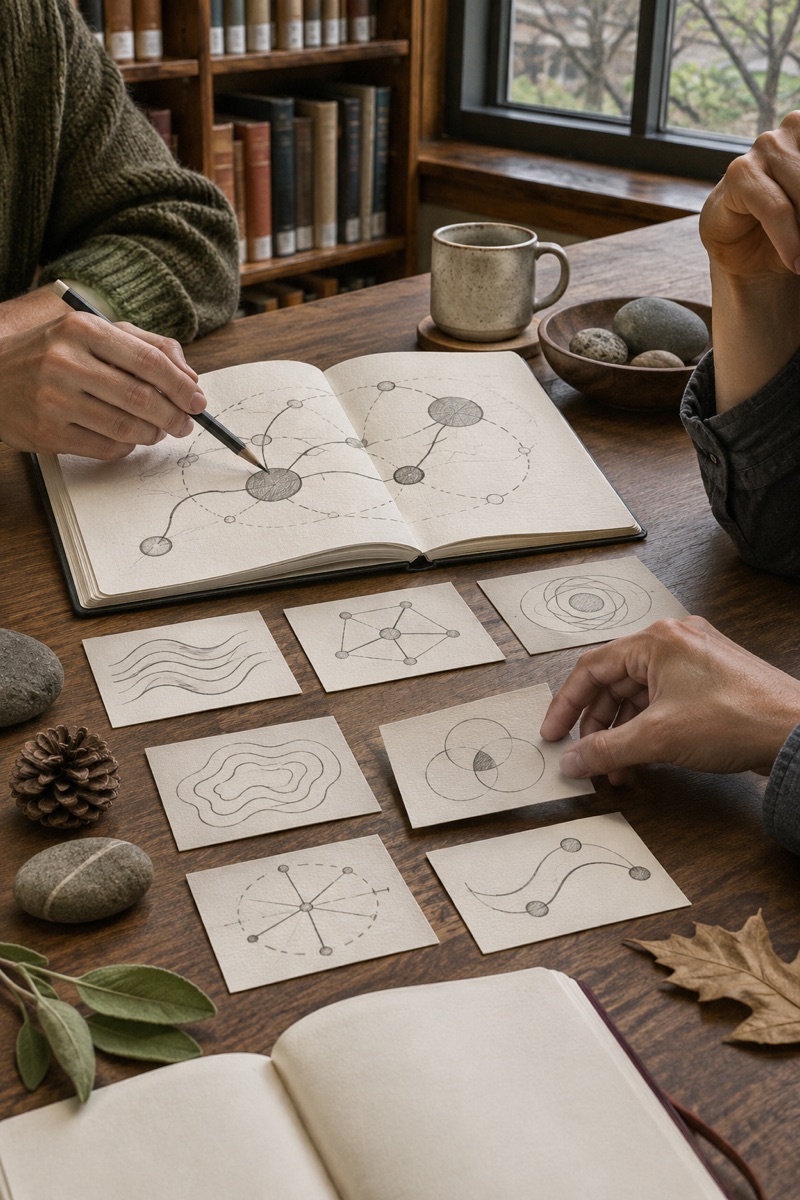
Paul organizes the book around three extensions: the body, physical spaces, and social relationships. Gesture can help structure an explanation. Walking or bodily sensation can change how a problem is represented. Notes and spatial arrangements can reduce internal memory demands. Conversation can distribute perspectives and error detection across a group.
This framing does not mean the brain is unimportant. It means cognition is often a system assembled for a task. A shopping list, a diagram, or a colleague is not merely background; each can change what the person can reliably do.
Where the evidence is strongest
Cognitive offloading has a clear experimental base. A 2025 meta-analysis found that external actions such as reminders improved performance on memory-based tasks, with larger benefits in forced-offloading conditions. It also found reduced differences among individuals in some settings. External structure can therefore compensate for limited internal memory rather than serving as a sign of weakness.
But support can create dependence. A 2026 experiment found that reminders improved the task they covered, while later performance fell when those reminders were removed. The lesson is not to reject tools. It is to decide whether the goal is reliable performance now, durable unaided learning later, or both.
Nature is promising, not magical
The book gives natural settings an important role in restoring attention. Systematic reviews provide partial support: some objective measures of working memory and cognitive flexibility improve after nature exposure, while many other measures show no clear advantage. Studies differ in duration, comparison settings, fatigue, and whether the exposure is real or virtual.
A park may be a valuable place to recover or think, but “nature restores attention” is not a universal law. Accessibility, safety, weather, disability, and personal associations matter. A quiet indoor space, pleasant view, or brief sensory change may be the more realistic extension.
Other people are not generic cognition devices
Paul is strongest when she shows that intelligence can be relational. Classic group research found a collective-performance factor associated with social sensitivity and more equal conversational turn-taking, not simply the smartest individual in the room. This makes group design—who speaks, who is heard, and how disagreement is handled—a cognitive issue.
Yet collaboration has costs: coordination, conformity, status pressure, interruption, and unequal credit. “Think with other people” is incomplete advice. The useful question is which phase benefits from solitude, which from diverse input, and which needs an accountable decision owner.
What the book underplays
The studies come from different tasks and populations, and the narrative sometimes smooths those boundaries. Short laboratory outcomes do not automatically transfer to long projects, classrooms, clinical conditions, or organizations. A strategy that helps an average participant may add sensory or social load for someone else.
The book also risks making structural problems sound individually solvable. Workers cannot redesign every noisy office, student, schedule, or meeting norm. Extended cognition depends on access to space, autonomy, technology, nature, and trustworthy collaborators. Better personal tactics do not erase those inequalities.
A practical reading protocol
- Name the cognitive demand. Is the bottleneck memory, idea generation, emotional regulation, comprehension, or coordination?
- Choose one extension. Try a sketch, movable cards, a walk, a quieter setting, or a structured conversation.
- Protect the skill you still need. If unaided recall matters, retrieve first and check the external aid second.
- Measure the task. Look at accuracy, return time, insight quality, or follow-through rather than whether the method felt clever.
- Keep accessibility visible. The best extension is one the actual person can use consistently and safely.
View on Amazon →
View on Amazon →
View on Amazon →
These are affiliate links. If you purchase, we may earn a small commission at no cost to you. We verified the listed editions. Read our disclosure.
The calm bottom line
The Extended Mind is a useful antidote to the fantasy that good thinking is produced by willpower inside an isolated brain. Its best idea is operational: arrange bodies, tools, places, and relationships so the task becomes easier to represent and complete. Treat the examples as experiments, not laws. Extend cognition deliberately, and keep track of which abilities you want the environment to support versus which you still need to learn.
Sources
Burnett and Richmond, cognitive-offloading meta-analysis, 2026; Fellers and Storm, offloading and later learning, 2026; Ohly et al., nature and attention systematic review, 2016; Woolley et al., collective intelligence, 2010.