Sleep-State Misperception: When You Feel Awake All Night

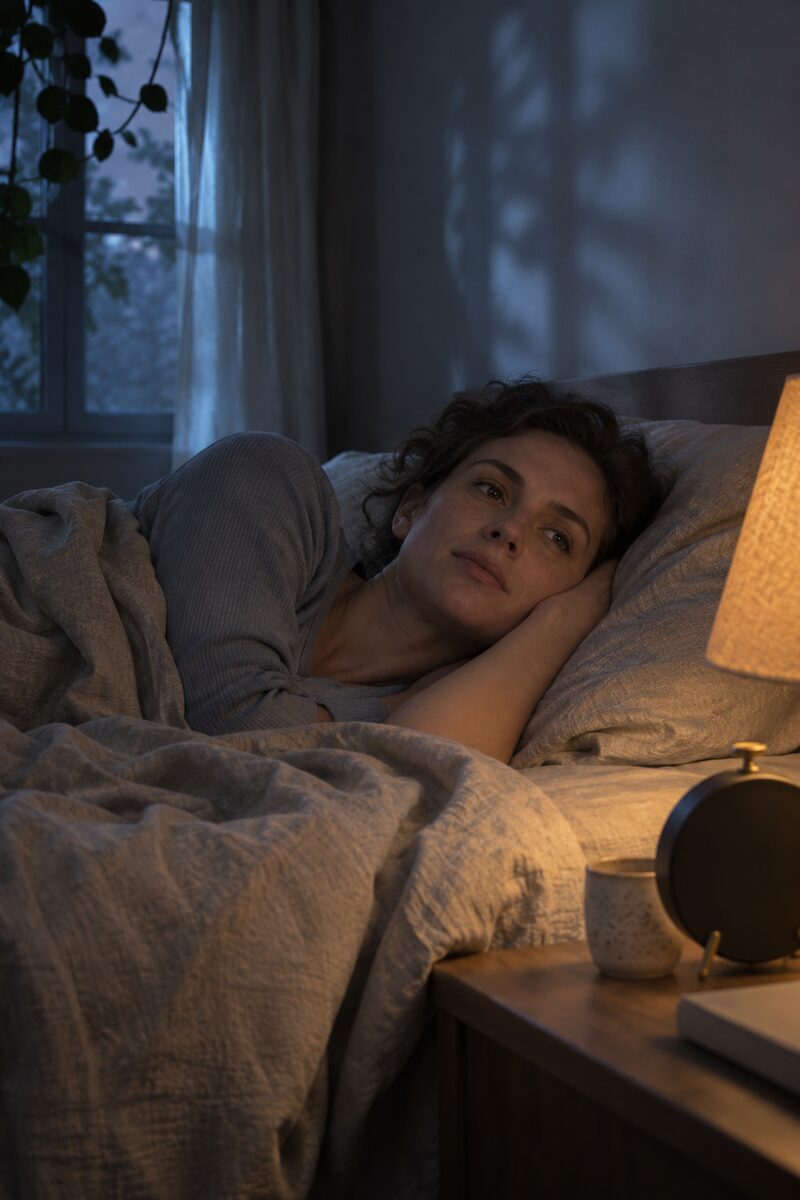
Some nights feel almost entirely awake. Yet a sleep study or a bed partner may suggest that sleep occurred. This mismatch is often called sleep-state misperception, subjective-objective sleep discrepancy, or, in older classifications, paradoxical insomnia.
The term can sound dismissive, as if the sleeper imagined the problem. That is not a useful interpretation. The experience of wakefulness is real. The scientific question is why conscious experience, morning recall, and standard measurements sometimes tell different stories.
Sleep is not a simple on-off state
Polysomnography classifies sleep using brain waves, eye movements, muscle activity, and other signals scored in short epochs. It is the clinical reference standard, but it compresses complex and changing brain activity into stages. A person can meet criteria for light sleep while retaining thoughts, environmental awareness, or a sense of time passing.
A 2023 systematic review argued that some apparent misperception may also be mismeasurement. Standard sleep staging can miss wake-like local or microstructural activity. Most people estimate sleep reasonably well, but a subgroup with insomnia consistently underestimates total sleep. This does not prove that either the subjective report or the laboratory record is the complete truth.
Why a night may feel more awake
Hyperarousal is one leading explanation. Worry about sleep can increase monitoring of bodily sensations, sounds, and time. Repeated checks make quiet wakefulness more memorable. Light sleep may contain enough cognitive activity to be remembered as wake, while deeper or dream sleep leaves fewer accessible memories.
A 2025 theoretical review linked sleep-state misperception with cognitive and neurophysiological arousal and reduced sensory gating. The authors emphasized an important limitation: many studies compare morning recall with polysomnography, so they cannot fully separate altered perception from retrospective reporting bias. More real-time awakenings and contemporaneous reports are needed.
Wearables do not settle the argument
Consumer trackers infer sleep largely from movement and heart-rate signals. They can be useful for broad patterns, but they do not read consciousness and are not equivalent to clinical polysomnography. A tracker may label still wakefulness as sleep or quiet sleep as wake. Treating its estimate as a verdict can intensify uncertainty.
When a device says seven hours and the person feels exhausted, neither data point should be weaponized. Daytime sleepiness, mood, concentration, medication, breathing symptoms, pain, circadian timing, and other health conditions still matter.
Why clock-checking makes the night harder
Looking at the time creates a calculation: hours left, sleep already lost, consequences tomorrow. That calculation raises arousal and strengthens memory for being awake. It also encourages repeated attempts to force sleep, an automatic process that does not respond well to effort.
Turning the clock away and keeping the phone out of reach will not cure chronic insomnia, but it removes a recurring cue for threat appraisal. The goal is not to convince yourself that you slept. It is to stop collecting evidence every few minutes.
CBT-I focuses on patterns, not persuasion
Cognitive behavioral therapy for insomnia, or CBT-I, is the first-line behavioral treatment for chronic insomnia. It typically includes a stable wake time, stimulus control, carefully managed time in bed, cognitive work, and relapse planning. The aim is not to debate a person out of their experience. It is to rebuild a stronger association between bed and sleep and reduce behaviors that maintain arousal.
Sleep restriction therapy should be individualized, especially for people with bipolar disorder, seizure disorders, safety-critical jobs, pregnancy, or substantial daytime sleepiness. A trained clinician can adapt the protocol. Generic advice to spend very little time in bed is not appropriate for everyone.
Use a diary without making it a courtroom
A simple sleep diary can reveal patterns over one or two weeks. Record bedtime, estimated sleep onset, awakenings, final wake time, rising time, naps, and daytime functioning. Estimates are allowed to be estimates. Avoid reconstructing every minute.
The useful unit is a trend, not a single night. If perceived sleep improves while daytime functioning improves, that matters. If severe sleepiness, near-misses while driving, loud snoring, gasping, unusual movements, or persistent impairment appears, seek clinical evaluation rather than assuming misperception.
A calmer response after a difficult night
- Do not use one night to predict the next week.
- Keep the usual wake time when it is safe to do so.
- Get morning light and ordinary daytime movement.
- Avoid compensating with an extremely early bedtime.
- Judge the day by function, not only by a tracker score.
If you feel dangerously sleepy, safety comes first: do not drive or operate equipment. Sleep-state misperception is not a label to apply without assessment, and it does not rule out sleep apnea, restless legs, circadian disorders, medication effects, depression, anxiety, or medical illness.
The honest takeaway
Feeling awake during measured sleep is possible because sleep contains mixed states, memory is selective, and measurement is imperfect. The mismatch is neither proof that nothing is wrong nor proof that no sleep occurred. It is a clue.
A constructive response validates the experience, reduces nightly measurement battles, and treats persistent insomnia with evidence-based care. The goal is not perfect certainty about every minute. It is safer nights, steadier days, and less fear around sleep.
View on Amazon →
View on Amazon →
View on Amazon →
These are affiliate links. If you purchase, we may earn a small commission at no cost to you. We only list books we researched. Read our disclosure.
Sources
Stephan et al., systematic review of sleep perception, 2023; Wood et al., sleep-discrepancy methods review, 2025; Reid et al., neurobiological mechanisms review, 2025; Edinger et al., AASM behavioral-treatment guideline, 2021.