
Sleep Fragmentation: Why Continuity Matters

Eight hours in bed can still feel unrefreshing when sleep is repeatedly interrupted. Sleep fragmentation means that continuity is broken by awakenings or shifts toward lighter sleep. Some awakenings are remembered; many are not. The pattern matters because restoration depends not only on total sleep time, but also on how sleep is organized across the night.
This is not a reason to fear every brief awakening. Normal sleepers move, change stage, and wake momentarily. The useful question is whether interruptions are frequent or prolonged enough to reduce daytime function, and whether a treatable cause is present.
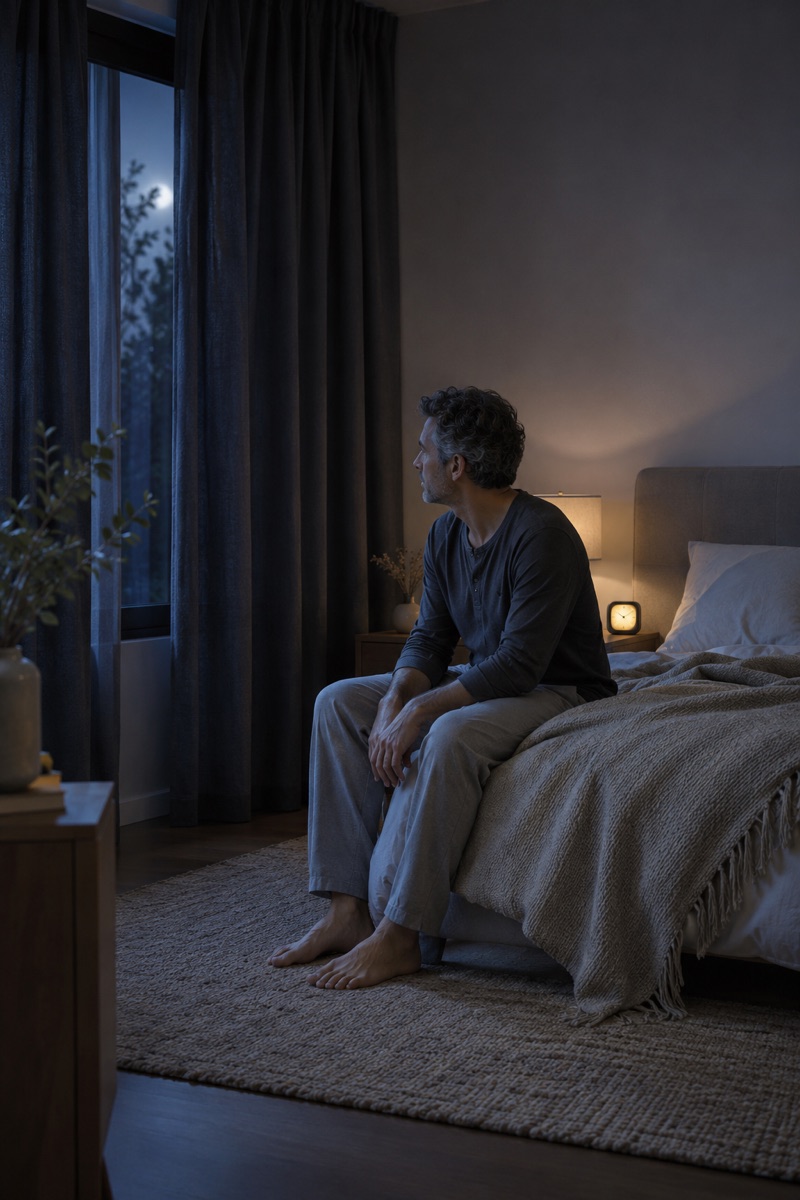
What continuity adds beyond duration
Laboratory work helps separate continuity from simple bedtime. In a randomized experiment, one night of forced sleep disruption sharply increased wake time after sleep onset and reduced total sleep time. The next day, participants reported more anxiety and less positive affect, and showed worse memory consolidation and vigilance. Yet several objective emotion-processing tasks did not change. That mixed result is important: fragmentation can impair specific functions without explaining every bad day.
A broader scientific review describes duration, timing, and continuity as partly independent dimensions. Two people can report similar hours asleep while differing in the number of transitions, the stability of deeper sleep, and the amount of wakefulness after initially falling asleep.
Common reasons sleep becomes fragmented
- Environment: noise, light, temperature, pets, caregiving, or a partner's movement.
- Breathing: obstructive sleep apnea can repeatedly interrupt sleep, often with snoring or gasping.
- Body symptoms: pain, reflux, hot flashes, itching, restless legs, or frequent urination.
- Substances and medication: alcohol may speed sleep onset while worsening later continuity; stimulants and some medicines can also interfere.
- Insomnia and stress: threat monitoring can turn ordinary awakenings into long periods of effortful wakefulness.
A wearable cannot reliably identify all of these causes. Consumer devices infer sleep from movement and physiology, and their stage estimates are not equivalent to clinical polysomnography.
Do not turn continuity into a performance score
Checking the clock after every awakening can increase arousal. So can chasing a perfect sleep-efficiency number. If you are awake briefly and comfortable, nothing needs to be solved. If you remain alert, use a low-light, quiet activity and return to bed when sleepiness comes back. The aim is to reduce struggle, not to manufacture unconsciousness.
Track only enough information to see patterns: approximate bedtime and wake time, notable awakenings, alcohol or late caffeine, symptoms, and morning function. A seven-night view is more useful than reconstructing every minute.
A practical continuity audit
- Keep wake time reasonably stable for a week.
- Reduce obvious noise and light without making the room a laboratory.
- Move caffeine earlier and observe whether alcohol precedes more second-half awakenings.
- Review fluids, pain, reflux, and medication timing with appropriate care rather than guessing.
- Judge change by daytime alertness and function as well as estimated sleep.
When insomnia persists, cognitive behavioral therapy for insomnia has stronger support than generic sleep-hygiene lists alone. It addresses time in bed, conditioned arousal, unhelpful beliefs, and the behaviors that keep wakefulness paired with the bed.
When evaluation matters
Seek clinical assessment for loud habitual snoring, witnessed breathing pauses, gasping, morning headaches, dangerous daytime sleepiness, repeated leg sensations, unusual movements, or persistent insomnia with impairment. Do not drive when dangerously sleepy. Sudden sleep disruption can also accompany mood episodes, medication changes, pain, or medical illness.
One fragmented night is usually a temporary stressor. Repeated disruption with symptoms deserves curiosity and care, not self-blame.
View on Amazon →
View on Amazon →
View on Amazon →
These are affiliate links. If you purchase, we may earn a small commission at no cost to you. We verified the listed editions. Read our disclosure.
The calm bottom line
Sleep continuity matters, but a brief awakening is not a failure. Look for repeated patterns, reduce obvious disruptions, and avoid turning sleep into a nightly exam. When fragmentation travels with breathing symptoms, unusual movements, persistent insomnia, or daytime impairment, evaluation matters more than another tracker score.
Sources
Reid et al., randomized sleep-continuity experiment, 2023; Van Someren et al., disrupted-sleep review, 2015; Medic et al., health consequences review, 2017; Burns et al., light exposure and sleep continuity, 2022.