
Resistance Band Training: What the Evidence Actually Shows

Resistance bands are often sold as either a gentle rehabilitation tool or a complete replacement for a gym. Both descriptions can be true in the right context. Elastic resistance can build strength and support physical function, but the result depends on effort, range of motion, progression, and a band setup that does not fail under tension.
Why bands feel different
A weight provides nearly constant external mass while leverage changes through the movement. An elastic band produces more force as it stretches. That ascending resistance can match some exercises well and others poorly. A squat may feel easiest at the bottom and harder near standing; a lateral raise may become disproportionately difficult near the top. The band is not automatically better or worse. It changes the resistance curve.
Because color is not standardized across manufacturers, “medium” has no universal load. Distance from the anchor, initial stretch, grip width, and band age all change tension. That makes precise comparison harder than adding plates to a bar, but progression is still possible if you record the setup.
What the trials show
A 2019 systematic review and meta-analysis comparing elastic resistance with conventional resistance found similar gains in muscular strength across healthy adults, older adults, and people with health conditions. The included studies were generally small and used different exercises and durations, so “similar” should not be read as proof that every band program equals every weight program. Read the review.
A 2024 review in older adults included nine controlled trials and reported improvements in chair-stand, flexibility, and timed-up-and-go performance. Heterogeneity was extremely high and the authors rated certainty very low. The responsible conclusion is that bands can be effective and accessible, while the exact size of benefit remains uncertain. Read the abstract.
The broader resistance-training literature is clearer about principles. A large 2023 network meta-analysis found that many combinations of load, sets, and frequency improve strength and muscle size compared with no training. Higher loads ranked best for maximal strength, while multiple sets mattered for hypertrophy. Bands can implement progressive resistance, but very strong lifters may find it easier to quantify and extend heavy loading with weights. Review the analysis.
How hard should a set be?
The final repetitions should slow while technique remains stable. For a general strength plan, choose a setup that allows roughly 8 to 15 controlled repetitions with two or three good repetitions still possible. Beginners do not need to train to failure. Stopping with a small reserve reduces unnecessary fatigue while still providing a meaningful stimulus.
Progress one variable at a time: add repetitions, increase band tension, shorten the working length, add a set, or choose a harder variation. When you reach the top of the repetition range for every set with consistent form, increase resistance and return to the lower end.
A simple full-body structure
Two or three weekly sessions can cover the major patterns: squat or split squat, hip hinge, row, press, and a trunk exercise. Perform two sets per movement at first. Use a smooth two-second lowering phase and avoid snapping into lockout. Forty-eight hours between similar sessions is a reasonable starting point, although recovery varies.
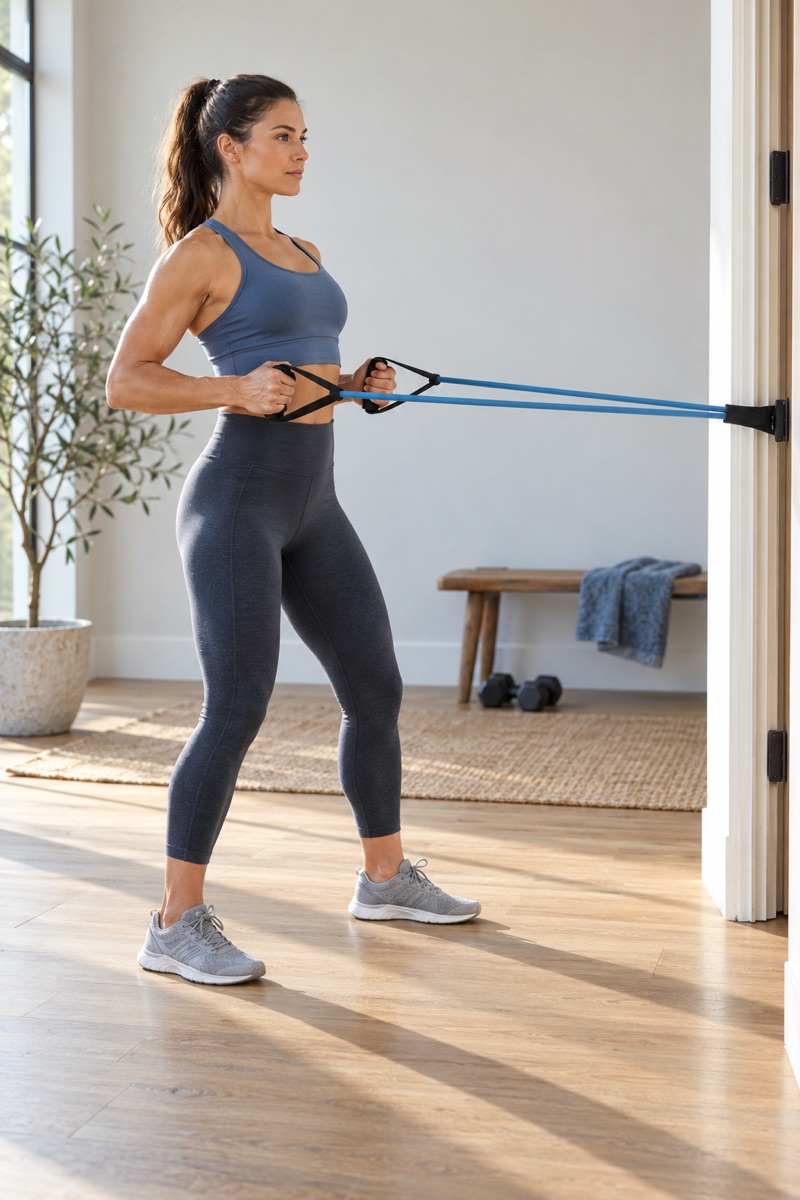
For legs, loop bands around the thighs add cueing and resistance but may be too light for long-term strength. Long bands can load squats, hinges, and assisted pull-ups through a larger range. Tubes with handles are convenient for rows and presses, provided the anchor is rated for the direction of pull.
Safety is mostly inspection and geometry
Before every session, inspect the band for cuts, thinning, chalky areas, cracks, or damage near handles. Retire a compromised band. Keep the line of pull away from the face and eyes. An anchor should close into a door so tension pulls the door shut, not open, and the door itself must be solid. Never attach a band to a sharp edge or an object that can move.
Latex allergy requires a clearly labeled latex-free product. Pain that is sharp, escalating, or changes movement is a reason to stop; rehabilitation after surgery or significant injury needs individual guidance. Elastic resistance is a tool, not a diagnosis.
The honest bottom line
Bands are portable, inexpensive, and capable of producing meaningful strength gains. They are especially useful for home training, travel, warm-ups, and people who value a low barrier to starting. Their limitations are load measurement, wear, anchoring risk, and the difficulty of providing very heavy resistance through some movements.
The best program is not the one with the most impressive equipment. It is the one that trains the major movement patterns, becomes gradually harder, and is performed consistently without avoidable injury. Bands can satisfy that standard—if you treat them as real resistance rather than colorful accessories.
View on Amazon →
View on Amazon →
View on Amazon →
These are affiliate links. If you purchase, we may earn a small commission at no cost to you. We only list products we researched. Read our disclosure.