
Muscle Protein Synthesis: What the Evidence Says About Protein, Timing, and Dose
Muscle is not simply structural tissue. It is the largest organ of glucose disposal in the body, a reservoir of amino acids during illness, and one of the strongest predictors of long-term metabolic health. Peter Attia, in Outlive, argues that preserving muscle mass is among the highest-leverage interventions available for extending healthspan — and the science of muscle protein synthesis is central to that argument. Understanding how skeletal muscle is built and broken down gives you a mechanistic reason to care about protein intake beyond aesthetics.
The Basic Mechanism
Muscle protein synthesis (MPS) refers to the process by which muscle fibers incorporate amino acids into new contractile proteins, primarily myosin and actin. MPS is offset by muscle protein breakdown (MPB), and the net balance between these two processes — positive or negative — determines whether muscle mass increases, stays the same, or declines. At rest in the fasted state, breakdown slightly exceeds synthesis. Exercise acutely elevates MPS for up to 24–48 hours. Dietary protein extends and amplifies this response.
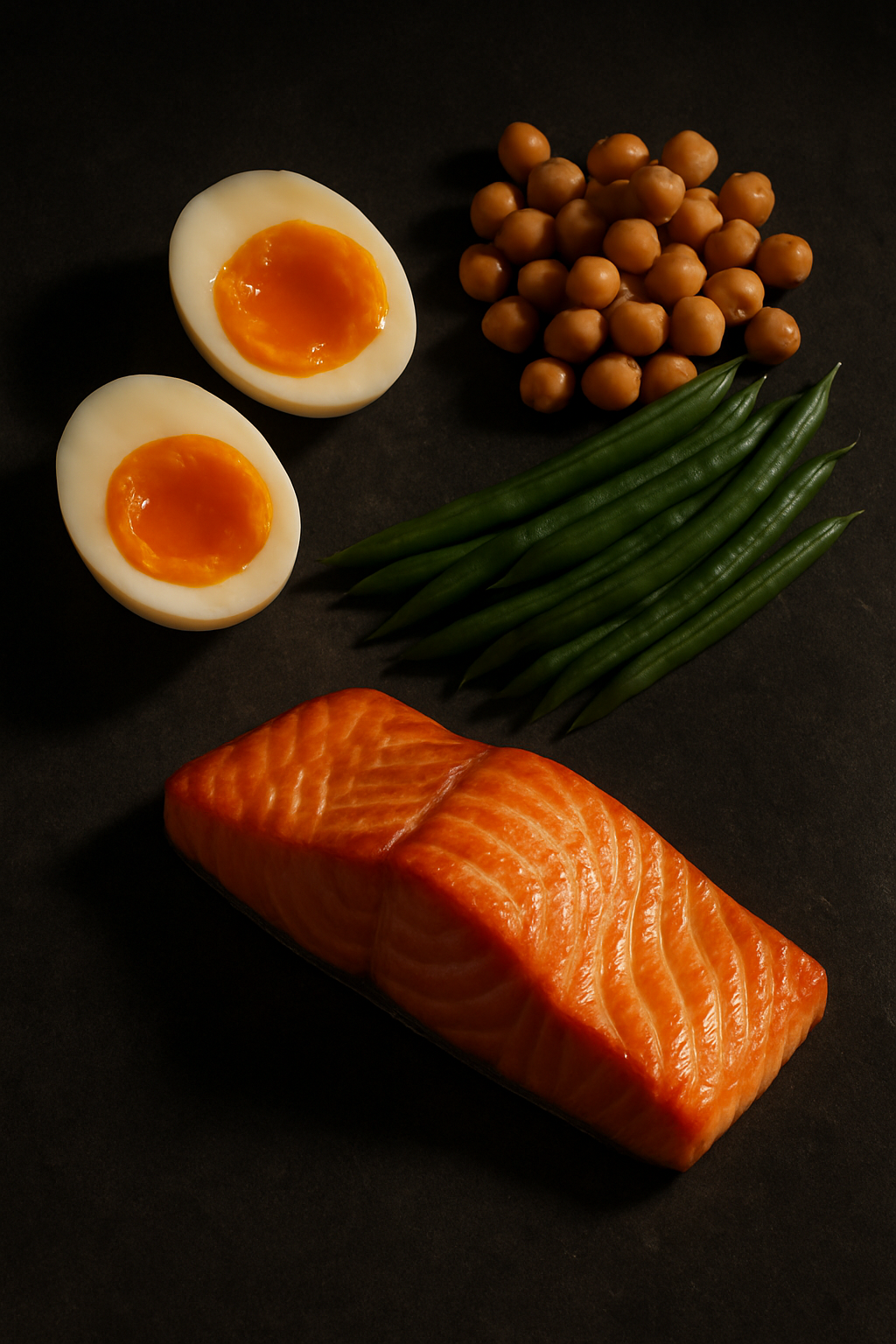
The signal for MPS is not simply protein intake — it is leucine specifically. Leucine is a branched-chain amino acid that directly activates mTORC1, the mechanistic target of rapamycin complex 1, which acts as the primary anabolic switch in skeletal muscle. A 2012 study in the Journal of Nutrition (Norton & Layman) established that approximately 2–3 grams of leucine are required to maximally stimulate MPS in healthy adults. Animal-based proteins — whey, eggs, meat — typically contain sufficient leucine per realistic serving. Many plant proteins do not.
How Much Protein Per Day
The RDA of 0.8 grams of protein per kilogram of body weight was designed to prevent deficiency in sedentary adults — not to optimize muscle retention or synthesis. Multiple meta-analyses, including Morton et al. (2018) in the British Journal of Sports Medicine, found that protein intakes up to 1.62 g/kg/day maximally supported resistance training adaptations, with no additional benefit beyond that threshold for most people.
For older adults, the calculation shifts. After approximately age 40, skeletal muscle becomes progressively less responsive to anabolic signals — a phenomenon called anabolic resistance. To achieve the same MPS response as a younger adult, older individuals typically need both more total protein (closer to 1.6–2.2 g/kg/day) and higher leucine concentrations per meal. A 2020 study in Nutrients (Trommelen et al.) confirmed that older adults require approximately 40 grams of high-quality protein per meal to achieve the same MPS response that 20 grams produces in younger subjects.
Protein Timing: What the Data Actually Shows
The "anabolic window" — the idea that protein consumed within 30 minutes post-workout is uniquely effective — was overstated. A 2013 meta-analysis by Schoenfeld & Aragon in the Journal of the International Society of Sports Nutrition found that when total daily protein intake is controlled, timing effects are modest at best. The more reliable finding is distribution: spreading protein intake across 3–4 meals, each containing enough leucine to maximally stimulate MPS (~30–40g of high-quality protein), is more effective than concentrating intake in one or two large meals.
Pre-sleep protein is an exception worth noting. Research by Res et al. (2012) in Medicine & Science in Sports & Exercise showed that 40 grams of casein protein consumed before sleep significantly increased overnight MPS rates compared to placebo. During sleep, protein synthesis remains active but substrate-limited without dietary amino acid supply. This is one area where timing genuinely matters.
Whey vs. Other Sources
Whey protein isolate has the highest leucine content per gram of any common protein source (approximately 11%) and the fastest absorption kinetics. It consistently outperforms casein and plant proteins in acute MPS studies, particularly post-exercise. However, when matched for leucine content, the MPS difference between animal and plant proteins narrows substantially — the issue with most plant proteins is leucine density, not amino acid quality per se.
Thorne Whey Protein Isolate and Momentous Strength Recovery Protein are both NSF Certified for Sport — a meaningful distinction because it means independent third-party testing for banned substances and label accuracy. The market for protein supplements has high rates of label inaccuracy and contamination; third-party certification reduces that risk substantially.
Practical Implications
For most adults over 40, the evidence supports targeting 1.6–2.0 grams of protein per kilogram of body weight per day, distributed across at least three meals, each containing 30–50 grams of a high-leucine source. Resistance training should precede or accompany this intake — protein without the anabolic signal from mechanical loading produces a blunted MPS response. For those who struggle to hit targets through food alone, whey protein isolate is the most evidence-backed supplemental option: fast-absorbing, high-leucine, and studied across hundreds of trials.
The less glamorous finding from this literature is that consistency beats optimization. A 2021 review in Sports Medicine (Stokes et al.) found that the chronic adaptations from protein supplementation depend primarily on sustained intake over weeks and months — not the precise timing of any individual dose. Habitual protein adequacy is the intervention, not any single protocol detail.
These are affiliate links — if you purchase, we earn a small commission at no cost to you. We only list products we've researched and believe in. Read our disclosure.