
Minimum Effective Dose Strength Training: How Little Can Work?

Strength programs are often presented as complete lifestyles: long sessions, many exercises, and detailed periodization. That can be useful for ambitious goals, but it creates a false choice for a busy beginner—train optimally or do nothing. Research suggests a third option. A small, progressive dose of resistance training can produce meaningful gains, especially when the starting point is no training at all.
“Minimum effective dose” does not mean the least discomfort possible or one universal workout. It means the smallest repeatable dose that moves a chosen outcome. The dose for learning basic strength is different from the dose for maximizing muscle size, powerlifting performance, or rehabilitation.
What the evidence supports
An updated American College of Sports Medicine overview synthesized 137 systematic reviews covering more than 30,000 participants. Resistance training improved strength, muscle size, power, endurance, balance, and several measures of physical function compared with no training. Many program variables mattered less consistently than popular debate suggests.
A 2023 Bayesian network meta-analysis reached a practical conclusion: every tested resistance prescription improved strength and hypertrophy compared with no exercise. Heavier loads ranked higher for maximal strength, while multiple sets helped hypertrophy. A review focused on minimal-dose approaches found that low-volume, higher-load training or brief, frequent “exercise snacks” can improve strength and function across age groups.
Minimum is a floor, not an optimum
The smallest useful program leaves gains on the table. More weekly sets generally produce more muscle growth, although the return diminishes. Strength responds to both practice and loading; people who want to maximize a specific lift usually need heavier, more specific work than a general health routine provides.
This distinction prevents two errors. The first is dismissing a brief program because it is not optimal. The second is advertising a tiny dose as equal to a well-designed larger one. A twenty-minute session can be enough to begin adapting. It is not automatically enough for every goal forever.
A practical two-day structure
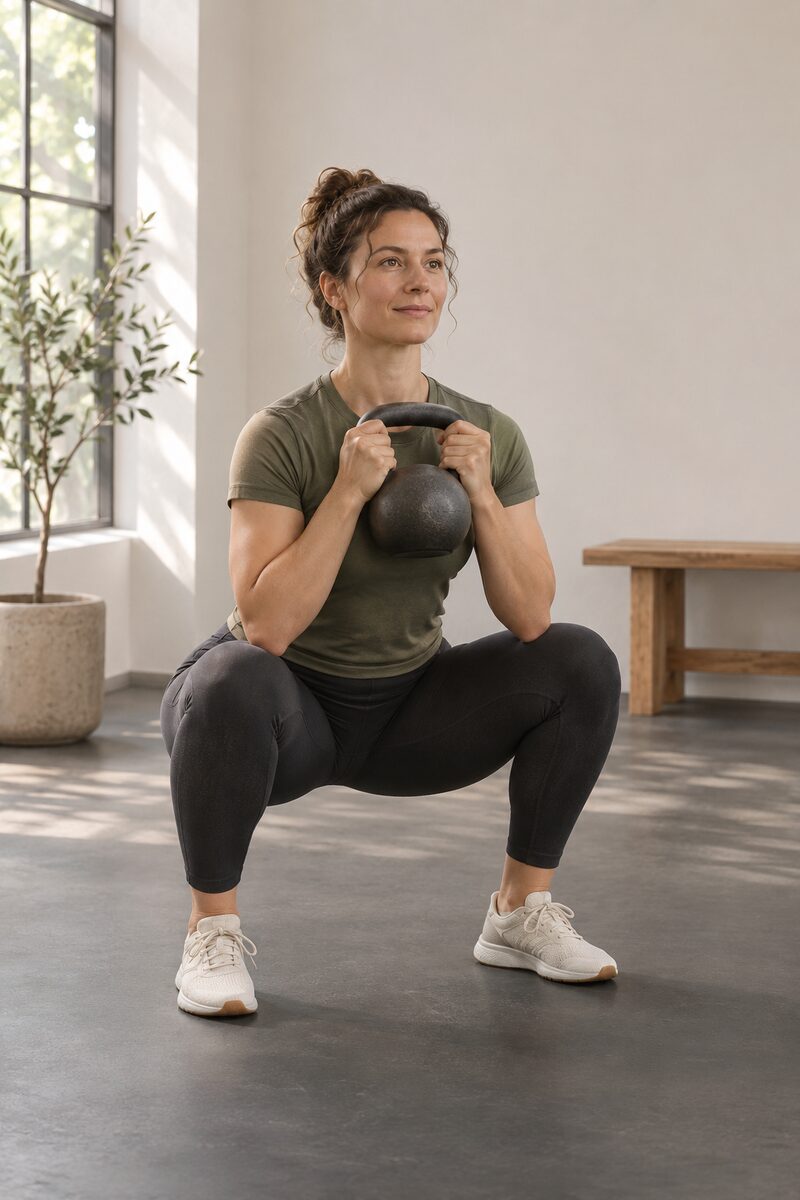
For a healthy novice, two nonconsecutive full-body sessions can cover the main movement patterns without making the week revolve around training. Each session can use four exercises: a squat or sit-to-stand, a push, a pull, and a hip hinge or loaded carry. Start with one or two challenging sets per exercise.
Choose a resistance that allows roughly six to fifteen controlled repetitions while leaving about two or three good repetitions in reserve. The exact range is less important than safe technique, enough effort, and gradual progression. Rest long enough that the next set is controlled—often one to three minutes.
- Warm up with five minutes of easy movement and lighter practice repetitions.
- Perform four multi-joint movements for one or two work sets each.
- Stop a set when technique changes or the next repetition would be uncertain.
- When the top of the repetition range feels controlled twice, add a small amount of load.
- Record the exercise, load, repetitions, and any pain—not calories or punishment.
Progression makes a small dose effective
A repeated workout is only training if the body receives a reason to adapt. Progress can mean one more repetition, a slightly heavier weight, a greater range of motion, better control, or a harder variation. It does not require increasing everything at once.
Beginners often improve quickly because skill and coordination develop alongside muscle. That is also why early gains do not prove a particular branded method is uniquely powerful. Almost any sensible progressive program can work when it replaces inactivity.
When to add more
Increase volume when progress stalls for several weeks despite consistent attendance, adequate sleep, sufficient food, and sound technique. Add one set to one or two priority movements before expanding the entire program. If a goal shifts toward maximal muscle growth, sport performance, or advanced strength, a larger and more specific dose will usually be required.
Do not add volume merely because a session felt short. Adherence is part of the dose. A program completed for twelve weeks provides more stimulus than an elaborate plan abandoned after ten days.
Safety and individual limits
Muscle effort, warmth, and temporary fatigue are expected; sharp pain, chest pressure, fainting, new neurological symptoms, or rapidly worsening joint pain are not. People with uncontrolled cardiovascular disease, recent surgery, significant osteoporosis, pregnancy complications, or conditions affecting balance should seek individualized guidance. A qualified professional can help adapt exercises and loading.
Training to complete muscular failure is not required for general progress and may add fatigue or technique breakdown. Use stable equipment, clear floor space, and movements you can exit safely. The best minimalist routine is not the most dramatic one. It is the one you can repeat and progress without accumulating avoidable problems.
View on Amazon →
View on Amazon →
View on Amazon →
These are affiliate links. If you purchase, we may earn a small commission at no cost to you. We only list editions we researched. Read our disclosure.
The calm bottom line
A small resistance-training dose can improve strength and function, particularly for beginners. Begin with two brief full-body sessions, a few stable movements, one or two challenging sets, and visible progression. Treat that as a credible floor—not a claim that less is always equal to more.
Sources
ACSM overview of reviews, 2026; Currier et al., network meta-analysis, 2023; Fyfe et al., minimal-dose review, 2022; Pelland et al., volume and frequency meta-regression, 2026.