
Lutein & Zeaxanthin: The Eye Health Supplement Guide
Lutein and zeaxanthin are carotenoids your body can't make on its own — they come exclusively from diet or supplementation, and they're the only carotenoids that accumulate directly in the macula, the part of the retina responsible for sharp central vision. Together they form what's called macular pigment, a natural filter that absorbs high-energy blue light before it reaches the light-sensitive photoreceptors underneath.
The AREDS2 Findings
The strongest evidence for lutein and zeaxanthin comes from the Age-Related Eye Disease Study 2 (AREDS2), a large randomized controlled trial funded by the National Eye Institute and published in JAMA in 2013. Researchers substituted lutein (10mg) and zeaxanthin (2mg) for beta-carotene in the original AREDS formula — largely because beta-carotene had been linked to increased lung cancer risk in smokers — and found the updated formula reduced progression to advanced age-related macular degeneration (AMD) in high-risk participants, with a more favorable safety profile.
It's worth being precise about what this means: AREDS2 was studied in people who already had intermediate AMD or advanced AMD in one eye — not healthy adults trying to prevent future decline. For that population, the evidence for slowing progression is genuinely strong. For general eye health in people without existing macular disease, the evidence is more observational — higher dietary intake and higher macular pigment optical density (MPOD) correlate with better visual function, but long-term prevention trials in healthy populations are limited.
Screens, Blue Light, and Visual Comfort
Separate from AMD, lutein and zeaxanthin have been studied for their effect on visual performance under blue-light-heavy conditions — the kind produced by phone, laptop, and monitor screens. Higher MPOD is associated with improved contrast sensitivity and reduced photostress recovery time (how quickly vision recovers after glare exposure). Several smaller trials in adults with heavy screen exposure found supplementation improved measures of visual fatigue and glare discomfort over 6–12 months, though sample sizes are modest and results aren't as robust as the AMD progression data.
Dietary Sources vs. Supplementation
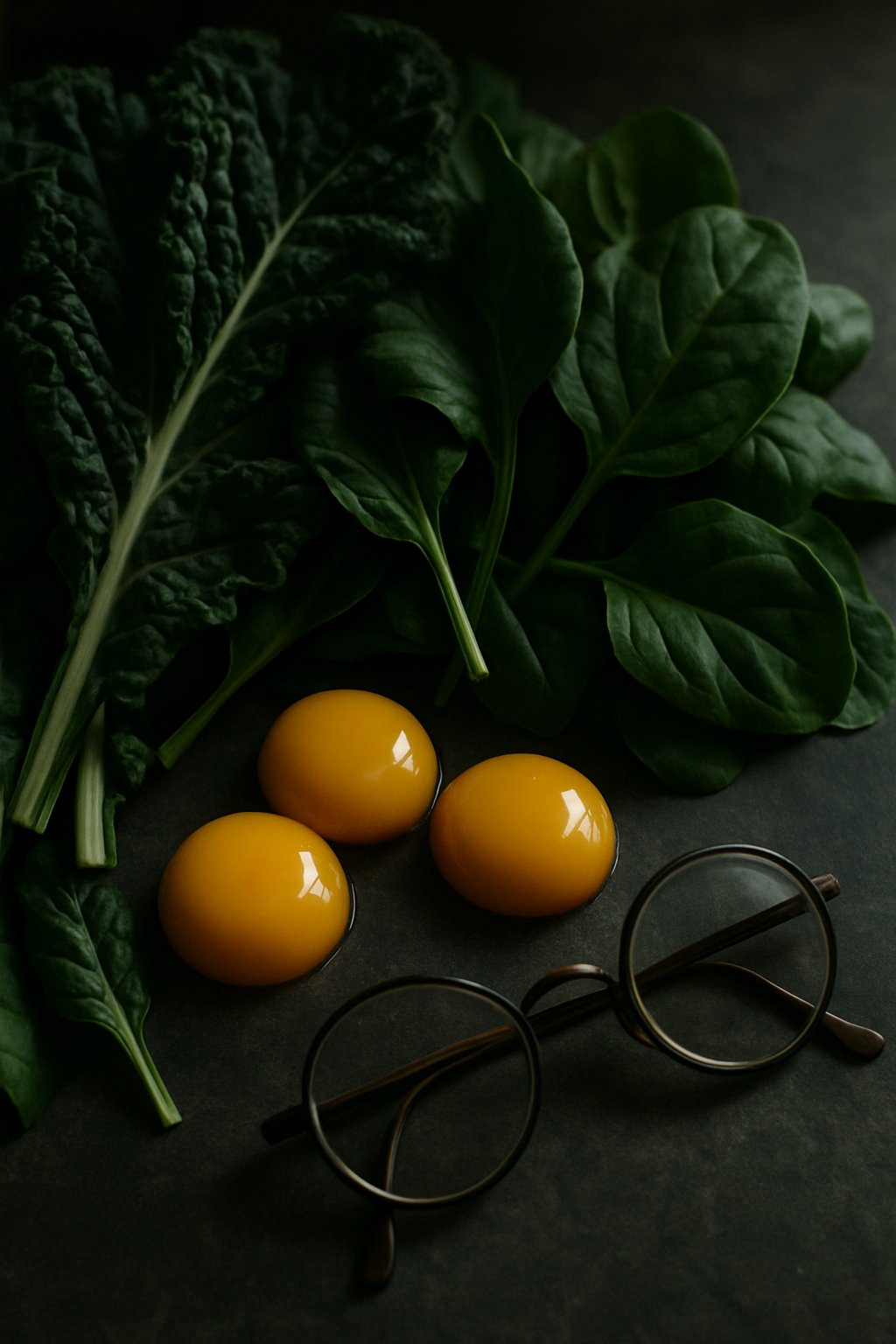
Dark leafy greens are the richest dietary source — kale, spinach, and collard greens contain far more lutein than egg yolks or corn, which are lower in concentration but more bioavailable due to the fat content that aids carotenoid absorption. Realistically hitting AREDS2-level doses (10mg lutein, 2mg zeaxanthin) through diet alone requires consistent daily servings of leafy greens most people don't maintain, which is where a standardized supplement closes the gap.
Dosing and Safety
Most formulations dose lutein at 10–20mg and zeaxanthin at 2–4mg daily, taken with a meal containing fat to improve absorption. Lutein and zeaxanthin are fat-soluble but, unlike vitamin A, don't carry known toxicity risk at typical supplemental doses — there's no established upper limit the way there is for retinol. Skin discoloration (carotenodermia) has been reported at extremely high, sustained doses well above standard supplementation, and resolves on discontinuation.
What to Look For
Check that the label specifies lutein and zeaxanthin as isolated compounds with stated milligram amounts, not a vague "eye health blend." Free lutein (as opposed to lutein esters, which must be cleaved before absorption) is somewhat more bioavailable, though esters remain effective. If the goal is matching the trial-tested AREDS2 ratio, look for products that mirror the 10mg lutein to 2mg zeaxanthin ratio specifically, like the NOW Foods formulation.
These are affiliate links — if you purchase, we earn a small commission at no cost to you. We only list products we've researched and believe in. Read our disclosure.