
Loaded Carries: An Evidence-Based Training Guide

Pick up a weight and walk with it. That simple instruction describes a family of exercises called loaded carries: farmer carries with weight on both sides, suitcase carries on one side, front-rack carries near the shoulders, and overhead variations for experienced lifters.
Carries are often sold as a complete answer for core strength, posture, grip, conditioning, and injury prevention. The movement is useful, but the evidence is narrower than the marketing. Studies can show which muscles are active or how gait changes under load; they do not automatically prove that one carry prevents back pain or outperforms conventional resistance training.
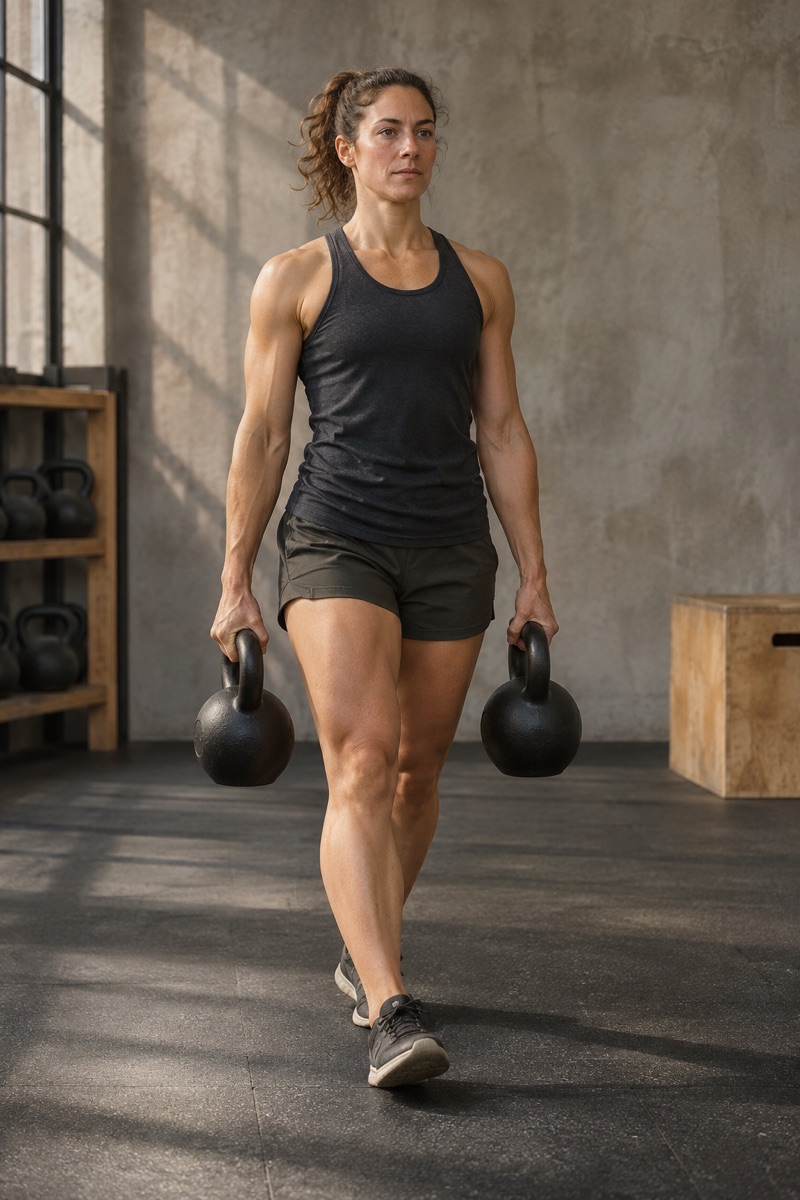
What a carry actually trains
The hands must maintain grip, the shoulders support a downward load, the trunk resists unwanted motion, and the legs continue producing steps. A bilateral farmer carry asks the body to stay tall under symmetrical load. A suitcase carry creates a stronger lateral challenge because the trunk must resist bending toward the weight.
A 2024 electromyography study compared farmer and suitcase carries with static holds. The carry conditions activated trunk musculature across several planes, while exercise choice and side changed the pattern. This supports carries as a plausible trunk-training option. It does not establish an ideal load, prove long-term hypertrophy, or show that the exercise treats back pain.
Start with the least complicated version
For most beginners, a two-handed farmer carry is easier to organize than an overhead carry. Use dumbbells, kettlebells, or purpose-built handles that can be picked up without rounding and twisting. Stand between the implements, brace gently, push through the floor, and finish the lift before walking.
Walk at a normal controlled pace. Keep the ribs stacked over the pelvis, let the arms hang naturally, and avoid turning the exercise into a shrug. The weights may move slightly; the goal is not robotic stillness. Set them down with the same care used to pick them up.
Choose a dose you can repeat
Distance is not the only way to prescribe carries. Time is often simpler in a crowded gym: 20–40 seconds of clean walking followed by enough rest to restore grip and breathing. Start with two or three work sets once or twice a week. End a set when posture or gait changes noticeably, not when the implements fall from the hands.
Load should be heavy enough to demand attention but light enough that the final steps resemble the first. A rating of perceived exertion around 6–7 out of 10 leaves room to learn. This is a starting heuristic, not a scientifically established threshold.
Progress one variable at a time
Add a small amount of time, distance, load, or another set—never all four at once. When three sets of 30–40 seconds feel stable for two sessions, a modest load increase is reasonable. If the available weight jump is large, extend time first or slow the progression.
Suitcase carries can be introduced after bilateral carries feel controlled. Use equal work on both sides, but do not force visual symmetry if pain, surgery, or neurological conditions make one side different. Front-rack carries increase upper-body demand. Overhead carries require sufficient shoulder motion and control and are optional, not an advanced badge everyone must earn.
Carries change gait under load
Research on occupational load carriage shows that external loads can alter step timing, forces, and trunk motion. That is one reason more load is not automatically better. A heavy carry is a resistance exercise, not ordinary walking with benefits that rise without limit.
Military and occupational studies sometimes involve long distances and heavy vests or packs. Their findings cannot be copied directly into a short gym carry. Equipment position, speed, terrain, fatigue, and training status all matter.
Where carries fit in a program
Carries work well near the end of a strength session, after the main lifts but before fatigue becomes chaotic. They can also form a short standalone practice with a warm-up. They do not replace squats, hinges, pushes, pulls, aerobic work, or balance training; they add locomotion under resistance.
Grip may be the limiting factor. That can be useful when grip is the target, but it may underdose the legs or trunk. Straps change the exercise and may be appropriate for some goals, though beginners usually benefit from first learning with a manageable unassisted load.
Safety boundaries
Stop for sharp pain, new numbness, dizziness, chest symptoms, or loss of control. People with recent surgery, uncontrolled blood pressure, hernia concerns, acute back or shoulder pain, balance impairment, or instructions to avoid heavy lifting should seek individualized guidance. Clear the walking path before lifting.
Muscle fatigue and heavier breathing are expected. Pain radiating into an arm or leg, a sudden grip failure, or repeated stumbling is not a cue to build character. It is a cue to stop and reassess.
A simple first session
- Warm up with five minutes of easy movement and several unloaded practice walks.
- Choose two weights you can lift and hold without breath-holding or leaning.
- Walk for 20 seconds, rest for 60–90 seconds, and repeat twice.
- Record load, time, perceived effort, and any change in gait or grip.
- Repeat the same dose once more before progressing.
The honest case for loaded carries is strong enough without exaggeration. They are compact, scalable resistance work that combines grip, trunk control, and walking. Treat them as one useful tool, progress them patiently, and judge success by repeatable movement rather than the heaviest possible trip across the gym.
View on Amazon →
View on Amazon →
View on Amazon →
These are affiliate links. If you purchase, we may earn a small commission at no cost to you. We only list books we researched. Read our disclosure.
Sources
Ellestad et al., loaded-carry muscle activation, 2024; Joseph et al., gait and trunk motion with occupational loads, 2023; Faghy et al., physiological responses to load-carriage training, 2020. Evidence from laboratory and occupational tasks should not be treated as proof of one optimal gym protocol.