Evening Exercise and Sleep: Timing Without Fear

“Never exercise at night” sounds clear, but it is not a good summary of the evidence. Many people train after work and sleep well. Exercise can support sleep over time, while a hard session very close to bedtime can keep some people warmer, more alert, and less ready to settle.
The useful question is not whether evening exercise is universally good or bad. It is how intensity, finish time, chronotype, meal timing, light exposure, and the individual response fit together.
What newer evidence adds
A 2026 systematic review compared morning with evening or nighttime exercise across 25 studies, including 18 randomized trials. It found no clear overall morning advantage for most sleep outcomes. Evening exercise was associated with modestly more wake after sleep onset, but the authors flagged possible small-study effects and found that differences appeared more likely with higher intensity.
That supports flexibility, not indifference. An earlier large wearable study followed 14,689 active adults across more than four million nights. Later and more strenuous evening sessions were associated with delayed sleep onset, shorter sleep, higher overnight heart rate, and lower heart-rate variability. Because this was observational and used consumer-device data, it cannot prove that exercise caused every change. People choose late workouts for reasons that may also affect sleep.
Why a hard late session may feel different
Vigorous exercise raises core temperature, heart rate, catecholamines, and arousal. Those responses normally settle during recovery, but bedtime may arrive before they do. Bright gym lighting, loud music, competition, a late pre-workout supplement, and a large post-training meal can add stimulation that is not exercise itself.
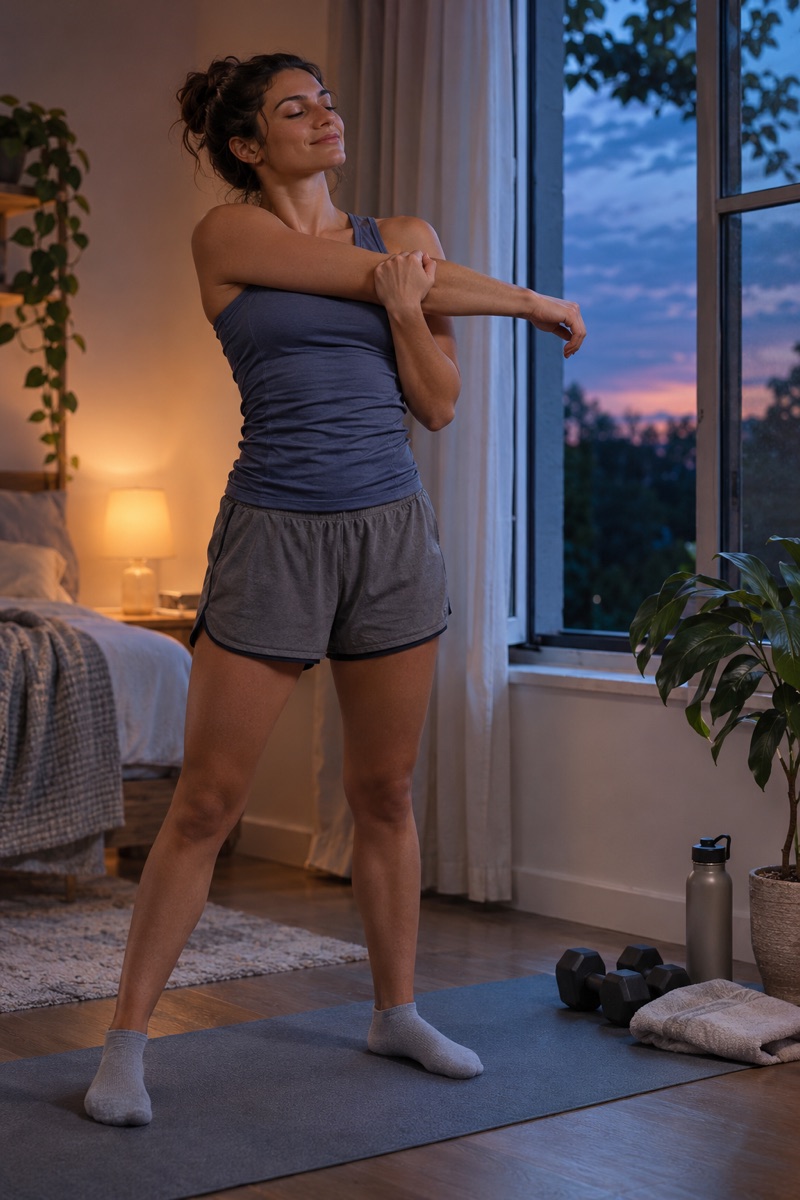
Moderate movement is different. A walk, easy cycling, mobility work, or submaximal lifting may finish without a large physiological tail. Treating every evening activity as equivalent hides the dose-response pattern.
Chronotype and baseline sleep matter
Early chronotypes may feel the same 9 p.m. session as much later biologically than night owls do. People with insomnia may also monitor their body closely and interpret normal post-exercise warmth as evidence that sleep is impossible. That expectation can become arousing in its own right.
At the same time, exercise generally improves subjective sleep quality, especially for people starting with poorer sleep. A 2026 meta-analysis of 200 trials found a small objective sleep-efficiency benefit and larger subjective benefits in those with worse baseline sleep, though certainty was rated very low. Regular activity may help even when the perfect clock time is unavailable.
A practical timing experiment
- Keep wake time reasonably stable for one week.
- Record when training ends, its intensity, caffeine, and the approximate time you attempt sleep.
- Track sleep onset, awakenings, morning alertness, and how the next session feels—without scoring every minute.
- If sleep repeatedly worsens after the hardest late sessions, move those sessions earlier or reduce intensity near bedtime.
- Keep easy evening movement if it helps and sleep remains stable.
One difficult night is not a verdict. Look for a repeatable pattern over several comparable days. Wearable numbers can add context, but they do not measure sleep stages with clinical accuracy and should not overrule daytime functioning.
Build a landing strip after training
Finish with five to ten minutes of low-intensity movement rather than stopping abruptly. Rehydrate normally, eat enough to recover without turning dinner into an enormous late feast, and avoid stimulant-containing pre-workouts late in the day. Lower the lights when practical and give yourself a quiet transition that does not require immediate sleep.
There is no universal three-hour rule. If vigorous training ends within about one to two hours of bedtime and sleep repeatedly suffers, more separation is a reasonable experiment. If you train late, cool down, and sleep well, the schedule may be acceptable.
When the problem is not exercise timing
Persistent insomnia, loud snoring, gasping, restless legs, unusual nighttime behaviors, or dangerous daytime sleepiness deserves clinical assessment. Moving a workout cannot diagnose or treat sleep apnea, circadian disorders, medication effects, depression, or other causes of sleep disruption.
If you feel dangerously sleepy, do not drive or operate equipment. People with cardiovascular disease, pregnancy, bipolar disorder, seizure disorders, or clinician-imposed exercise limits should individualize timing and intensity with qualified care.
View on Amazon →
View on Amazon →
View on Amazon →
These are affiliate links. If you purchase, we may earn a small commission at no cost to you. We verified the listed editions. Read our disclosure.
The calm bottom line
Evening exercise is not automatically a sleep mistake. Most outcomes do not show a clear universal advantage for morning training, but very late, strenuous sessions can impair sleep continuity for some people. Protect regular activity, adjust the hardest sessions when a repeatable problem appears, and use your own pattern—not a blanket rule—as the final practical test.
Sources
Souabni et al., timing systematic review and meta-analysis, 2026; Jones et al., evening exercise dose-response study, 2025; Ng et al., exercise and sleep-quality meta-analysis, 2026; Yang et al., exercise-timing systematic review, 2026.