
Cluster Sets in Resistance Training: What the Evidence Shows

A traditional resistance-training set asks you to complete several repetitions before resting. A cluster set puts brief pauses between individual repetitions or small groups of repetitions. Six continuous squats might become three pairs separated by twenty seconds. The load and total repetitions can stay the same, but the quality of later repetitions often changes.
This method is sometimes marketed as a shortcut to greater strength, power, and muscle. The research supports a narrower claim. Cluster structures can preserve movement speed and reduce fatigue within a session. Over weeks of training, however, they usually produce strength and muscle gains similar to traditional sets when volume and effort are comparable.
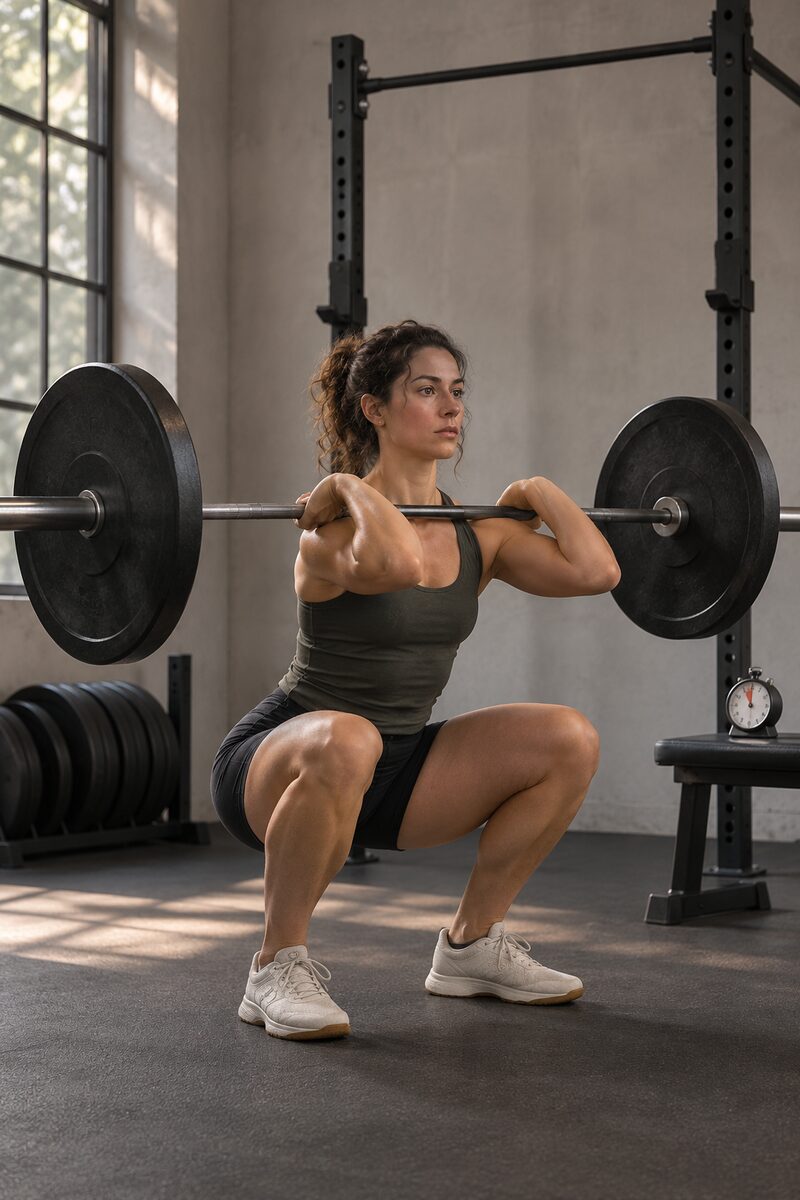
What makes a set a cluster set?
Cluster sets include extra rest inside the set. One model uses ten to thirty seconds after every repetition; another uses a short pause after two or three repetitions. This differs from rest redistribution, where a fixed amount of rest is rearranged rather than increased. That distinction matters because adding rest can make a session longer and can partly explain why fatigue falls.
The purpose is usually to limit the decline in bar speed, power, or technique as repetitions accumulate. It is not to make every workout easy. A heavy cluster can still be demanding, and the final repetitions can still approach failure if the prescription calls for it.
The acute advantage: preserving velocity
A 2026 systematic review of 37 studies found that cluster sets and other alternative structures preserved mean movement velocity better than traditional sets. Cluster sets had the highest probability of ranking first for mean and peak velocity, but direct differences among alternative structures were small. Earlier meta-analyses also found less decline in velocity and power, lower lactate accumulation, and lower perceived exertion during cluster-style work.
That makes clusters useful when repetition quality is the main target: Olympic-lift derivatives, jumps, throws, or strength exercises performed with an explicit intent to move quickly. A pause can allow partial recovery of phosphocreatine and reduce the fatigue that slows later repetitions. The result is not free energy; it is a different distribution of work and rest.
Long-term outcomes are less dramatic
Acute speed does not automatically become superior adaptation. A 2021 meta-analysis found no clear difference between cluster and traditional sets for strength, power, velocity, hypertrophy, or muscular endurance. A newer review of lower-body training similarly reported comparable strength and jump improvements, with only a small advantage for explosive power in some conditions.
These findings do not make cluster sets pointless. They show that the method is a tool, not a universal upgrade. If a lifter values power quality, technical consistency, or lower local fatigue, equal long-term gains may be a good result. If the goal is simple hypertrophy and time is limited, extra pauses may make the session longer without adding muscle growth.
A practical way to test clusters
Use clusters first on one stable, familiar exercise rather than redesigning the whole program. Keep the weekly load and total repetitions similar so you can judge the set structure itself. For example, replace three sets of six continuous repetitions with three sets of three clusters of two repetitions. Rest fifteen to twenty seconds within the set and two to three minutes between full sets.
- Choose a load you already control for six clean repetitions; do not test a maximum.
- Perform two repetitions, rack or safely support the load, and rest fifteen to twenty seconds.
- Repeat until six total repetitions are complete.
- Stop if technique changes, pain appears, or the setup makes re-racking unsafe.
- Track load, repetitions, total rest, perceived effort, and whether speed visibly collapsed.
Run the comparison for three to four weeks. If quality improves without making the session impractical, keep it for the exercises where speed matters. If the extra setup becomes distracting or the same progress occurs with ordinary sets, simplicity wins.
Who should be cautious?
Beginners need consistent technique more than advanced set structures. They can learn with ordinary sets, manageable loads, and clear rest periods. Cluster prescriptions also require safe equipment: repeatedly un-racking a heavy bar can introduce more opportunities for error. Use pins, spotters, or exercises that can be stopped safely.
People training around pain, recent injury, cardiovascular limitations, or balance problems should receive individualized guidance. Short rests can preserve movement speed while keeping the load high; feeling less fatigued does not mean the tissue or cardiovascular demand is trivial. Pain, dizziness, chest pressure, or loss of control are reasons to stop.
View on Amazon →
View on Amazon →
View on Amazon →
These are affiliate links. If you purchase, we may earn a small commission at no cost to you. We only list editions we researched. Read our disclosure.
The calm bottom line
Cluster sets reliably change the experience of a set: they help preserve speed and power and often reduce fatigue. They do not reliably outperform traditional sets for long-term strength or muscle growth. Use them when repetition quality supports a specific goal, keep volume and rest transparent, and judge the method by progress—not novelty.
Sources
Nagatani et al., velocity systematic review, 2026; Kong et al., lower-limb meta-analysis, 2026; Davies et al., chronic adaptations meta-analysis, 2021; Jukic et al., fatigue meta-analysis, 2020.