Bedtime Procrastination: Why You Delay Sleep and What Helps

You are tired, nothing urgent is keeping you awake, and yet bedtime slides another forty minutes. This pattern has a research name: bedtime procrastination, usually defined as going to bed later than intended without an external reason. It is not the same as insomnia. The problem is delaying the attempt to sleep, not necessarily being unable to sleep once you try.
The label can be useful because it shifts the question from “Why am I bad at sleep?” to “What makes the transition into sleep hard tonight?” But it can also oversimplify. Parents, shift workers, caregivers, and people with unpredictable jobs may have genuine constraints. A late bedtime is only procrastination when a realistic opportunity for sleep exists and the person voluntarily postpones it.
What the evidence actually shows
A systematic review and meta-analysis of 43 studies found moderate associations between greater bedtime procrastination and shorter sleep, poorer sleep quality, and more daytime fatigue. It also found links with lower self-control and a later chronotype. The review rated the certainty of the evidence low, however, and most studies were observational. Association does not prove that procrastination alone caused the sleep problem. Read the review.
A later review that screened studies through March 2025 reached a similar cautious conclusion. Most included samples were students, measurement methods varied, and proposed prevalence estimates ranged widely. That makes dramatic claims about how common the problem is unreliable. The consistent signal is narrower: people who report more bedtime delay also tend to report worse sleep outcomes.
Daily-diary research adds useful detail. On nights with more bedtime procrastination, participants generally reported poorer sleep. Self-compassion was associated with better outcomes but did not erase the effect of delay. Another diary study examined stress, procrastination, and subsequent sleep, supporting the idea that the evening is shaped by the day that came before it rather than by willpower in isolation.
Why the last episode wins
Bedtime is a transition away from rewarding, controllable activity toward a delayed benefit. One more video offers pleasure now; tomorrow’s alertness is abstract. Fatigue also weakens planning at the exact moment a plan must be executed. If the day felt overcontrolled, late-night leisure can feel like the only personally owned time. Calling that “revenge bedtime procrastination” may resonate, but it is a cultural phrase rather than a separate clinical diagnosis.
Evening chronotype matters too. A person whose biological preference runs late may face a schedule mismatch, especially when work demands an early rise. Simply demanding an earlier bedtime can produce more time awake in bed. The practical target is not an arbitrary clock time. It is a consistent sleep opportunity that fits the required wake time and allows adequate duration.
Use a shutdown cue, not a heroic decision
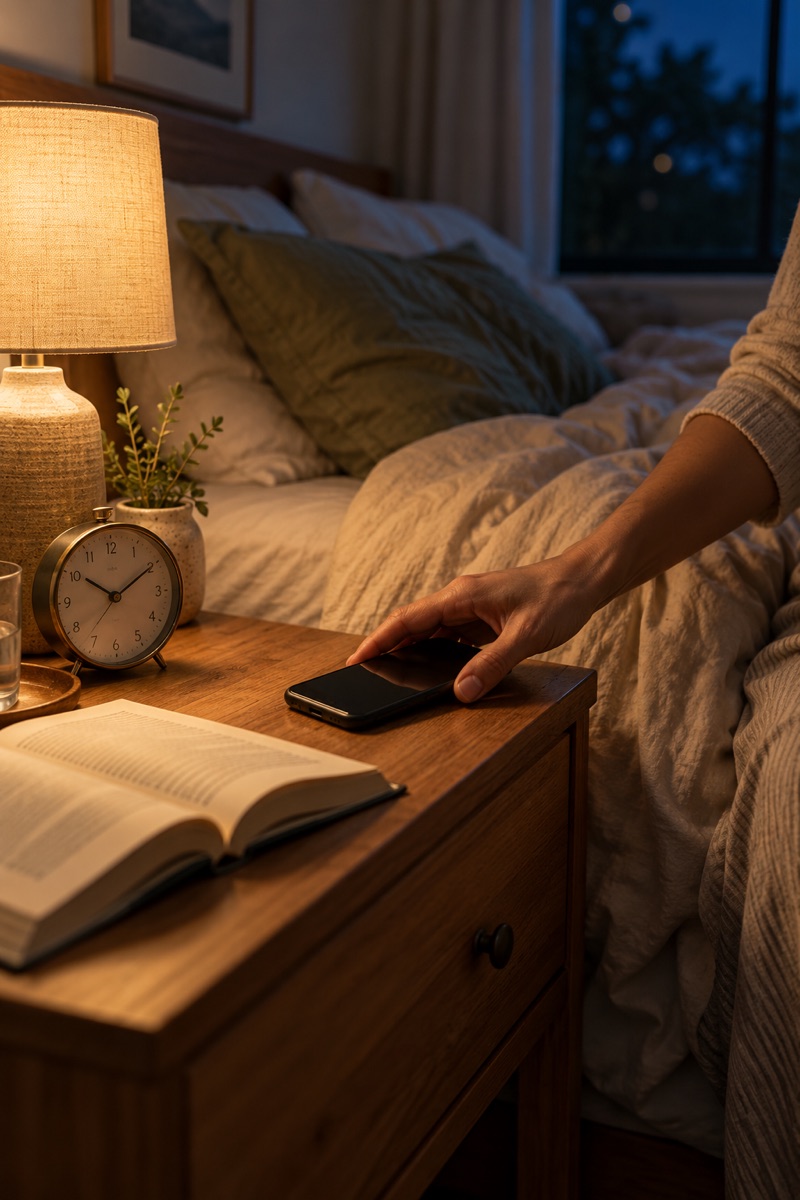
A good plan reduces the number of decisions made while tired. Choose a cue 30 to 45 minutes before the intended lights-out time: a lamp changes, an alarm sounds, or the phone begins charging outside the bedroom. The cue starts a short sequence—finish the current activity, prepare for morning, wash, and move to a low-stimulation option. Keep the sequence small enough to repeat on an ordinary bad day.
Implementation intentions can make the boundary more concrete: “When the 10:15 alarm sounds, I will plug the phone in the kitchen and open my paperback.” This is not magic. It links a visible situation to one action, so the tired brain does less improvising. If the routine takes an hour and contains twelve wellness tasks, it becomes another project to avoid.
Protect leisure before bedtime
If delay is the only available autonomy, removing it without replacing it is unlikely to last. Schedule a defined period of enjoyable, guilt-free leisure earlier in the evening. Decide in advance what “enough” looks like—one episode, twenty pages, or thirty minutes—then preserve the final transition for sleep. This reframes bedtime as protecting tomorrow rather than surrendering the present.
Technology controls can add friction, but friction should match the problem. Automatic do-not-disturb settings, grayscale, app limits, a separate alarm clock, or charging the phone across the room may help. A locking container is a stronger option and should never hold a device needed for emergencies. No gadget compensates for an unrealistic schedule.
A seven-night experiment
For one week, record the intended bedtime, actual attempt time, the activity that filled the gap, and the next morning’s wake time. Do not score sleep quality with false precision. The useful measure is the delay between intention and action. Then change one lever: move leisure earlier, set a shutdown cue, or remove the most repeatable distraction.
Keep wake time reasonably stable and avoid “fixing” one late night by spending most of the next morning in bed, which can push the following night later. If you are not sleepy at the planned time, use dim light and a quiet activity outside bed until sleepiness arrives. Bed should not become a place for frustrated scrolling.
When it is not a habit problem
Persistent difficulty sleeping despite adequate opportunity, loud snoring or gasping, restless legs, severe daytime sleepiness, mania, depression, or medication effects deserve clinical assessment. Cognitive behavioral therapy for insomnia is the first-line psychological treatment for chronic insomnia; a phone basket is not a substitute. Likewise, caregivers and shift workers may need structural support rather than stricter self-control.
The honest bottom line
Bedtime procrastination is a useful behavioral description, not a moral diagnosis. Evidence links it with shorter and poorer sleep, but the literature is still dominated by self-report and student samples. The most reasonable response is a small experiment: protect earlier leisure, attach one action to a reliable shutdown cue, and measure whether the intention-to-bed gap actually narrows.
View on Amazon →
View on Amazon →
View on Amazon →
These are affiliate links. If you purchase, we may earn a small commission at no cost to you. We only list products we researched. Read our disclosure.